

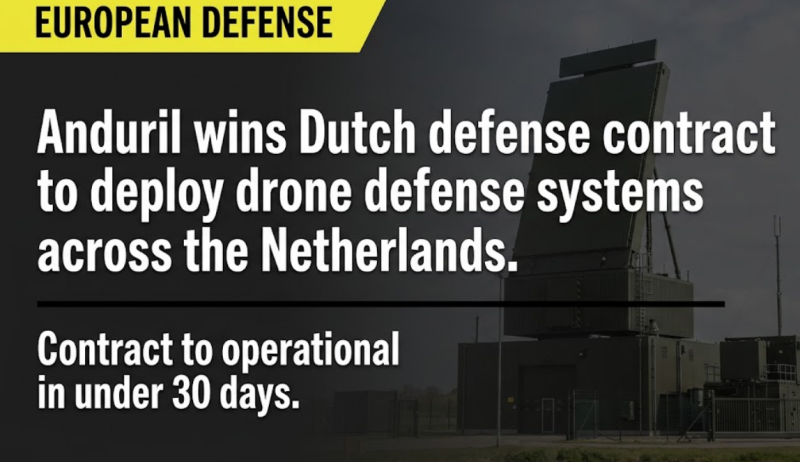
From contract signature to operational in under 30 days — and nobody is asking how.
THE HAGUE — Anduril Industries is expanding its footprint in Europe, and the Netherlands just handed it the door.
The Dutch Ministry of Defense awarded the American defense technology startup a contract to deploy counter-drone systems across the country — and Anduril wasted no time turning the announcement into a marketing event, leading with the claim that it moved from contract signature to operational capability in under one month.
That timeline is the story. And not in the way Anduril wants it to be.
Defense procurement exists the way it does for a reason. Oversight. Testing. Accountability. The slow, bureaucratic process that Silicon Valley defense companies love to mock is the same process that catches flawed systems before they fail in the field, before soldiers depend on them, and before foreign governments hand control of their airspace to a company whose primary product is its own press releases.
Anduril did not describe what "initial operating capability" actually means in this context. It did not specify how many systems were deployed. It did not say what was tested, what was validated, or what independent verification — if any — confirmed the systems were ready. It said it was fast. It said it was scalable. It said the Netherlands should be a model for how procurement works.
What it did not say is who is watching.
Anduril's Lattice system — the software backbone the company markets as the connective tissue of modern autonomous warfare — is being positioned as the command-and-control layer for Dutch air defense. That means an American private company's proprietary software is now embedded in a NATO member's defense infrastructure. The interoperability implications alone warrant a conversation that nobody appears to be having publicly.
The company frames the Ukraine war as the justification. Drones are proliferating. The threat is evolving. Speed is survival. That framing is not entirely wrong — but it is the same framing defense contractors have used for decades to move money and contracts before scrutiny catches up. Urgency is the oldest sales tool in the defense industry, and Anduril has built its entire brand around it.
Palmer Luckey's company has gone from building VR headsets to embedding itself in European national defense in under a decade. It has done so not by winning wars or proving systems in sustained combat operations, but by winning contracts, generating headlines, and telling governments that the old way of buying defense is too slow for the modern threat.
The Netherlands bought it. Literally.
What Europe gets in exchange for speed is a dependency — on Anduril's software, Anduril's hardware integrations, and Anduril's continued existence as a solvent company — built into the foundation of its air defense architecture. And what Anduril gets is a European beachhead, a case study it will pitch to every other NATO member currently panicking about drones, and another billion-dollar market it did not exist in five years ago.
The drone threat is real. The need for faster procurement is legitimate. None of that means the answer is handing a Silicon Valley startup unchecked access to allied defense infrastructure on a 30-day clock with no public accounting of what was actually delivered.
Anduril called this contract a demonstration of what is possible. It is. It's a demonstration of what is possible when a well-funded company with a good marketing operation moves faster than the oversight designed to keep it honest.
Add comment
Comments