


The defense startup has never built a space weapon. The Space Force just handed it billions to try.
WASHINGTON — Anduril Industries wants you to believe it is building the future of American defense. What it is actually building right now is a very large government contract.
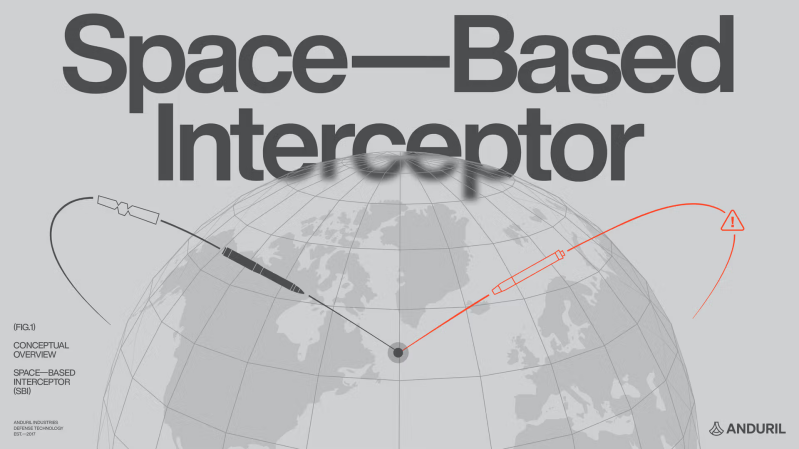
The Silicon Valley defense startup announced this week that it is leading a team of industry partners under contract with the U.S. Space Force to develop space-based interceptors — weapons designed to destroy enemy missiles from orbit — as part of President Donald Trump's Golden Dome initiative. The announcement was polished, heavy on corporate language, and notably short on specifics about what Anduril has actually built, tested, or proven in space.
What is not short on specifics is the money. The Space Force awarded 20 Other Transaction Authority agreements worth up to a combined $3.2 billion to 12 companies, including Anduril, in late 2025 and early 2026. OTA contracts — the same contracting mechanism used throughout the announcement — exist specifically to bypass standard federal acquisition rules. They move faster. They require less transparency. And they are increasingly the preferred vehicle for handing billions of taxpayer dollars to defense technology companies with limited track records in the mission areas they are being paid to develop.
Anduril was founded in 2017 by Palmer Luckey, the entrepreneur who sold Oculus to Facebook and was subsequently fired. The company has grown rapidly on the strength of government contracts, a aggressive marketing operation, and a Silicon Valley narrative that frames defense contracting as disruption. It makes drones. It makes border surveillance systems. It makes autonomous weapons platforms. What it has not done, at any documented scale, is build, launch, or operate weapons systems in space.
That did not stop the Space Force from handing it a contract to do exactly that — with a deadline of 2028.
The 2028 target date for demonstrating an initial interceptor capability is not a soft goal. It is the publicly stated milestone driving the entire program. Defense experts and the Space Force's own leadership have already raised alarms about whether it is achievable. "We are so focused on affordability," Space Force Gen. Michael Guetlein told a House Armed Services subcommittee in April. "If we cannot do it affordably, we will not go into production." That is not the language of a program on track. That is the language of a program quietly preparing its exit ramp.
The broader Golden Dome initiative is projected to cost $185 billion. Some estimates run higher. Congress has allocated $25 billion over a decade, with $5.6 billion specifically for space-based intercept capabilities. The gap between what has been funded and what the program is projected to cost is not a rounding error. It is the size of most countries' entire defense budgets.
Anduril's announcement this week leaned heavily on the language of urgency. Near-peer adversaries. Exotic maneuverable vehicles. Zero reaction time. The threats are real. The framing is not wrong. But urgency has historically been the most reliable mechanism for moving government money to private contractors before the hard questions get asked — and the hard questions here are significant.
Space-based interceptors have been described by independent analysts and the Space Force's own officials as a key but unproven component of Golden Dome. The physics are understood. The engineering has not been demonstrated at operational scale by anyone, including the legacy defense primes who have been trying for decades. Anduril is now positioning itself as the company that will do in three years what the established defense industry has not done in thirty.
The partners Anduril assembled for this effort — Impulse Space, Inversion Space, K2 Space, Sandia National Labs, and Voyager Technologies — represent a mix of early-stage commercial space startups and established research institutions. K2 Space, which will provide satellites to host the interceptors, is building platforms it describes as bigger and more powerful than anything currently on orbit. That is an ambitious claim from a company that has yet to launch one.
None of this means the program will fail. Some of it may work. The commercial space industrial base has demonstrated genuine capability in recent years, and the competitive OTA structure is designed to preserve flexibility for the government to move money toward what actually performs.
But Anduril is not a neutral participant in this story. It is a company with a financial interest in the outcome, a marketing infrastructure built around projecting confidence, and a press release that described the Department of War — the rebranded Department of Defense — without a single line of explanation or context for what that rebranding means or who decided it.
The Space Force needs space-based interceptors. The threat environment is real. The urgency is legitimate.
What the public also needs is an honest accounting of who is getting paid, on what timeline, under what oversight, to build something that has never been built — and what happens to the $3.2 billion if 2028 comes and the interceptors are not ready.
Anduril's announcement did not answer any of those questions. It was not designed to.
Add comment
Comments