

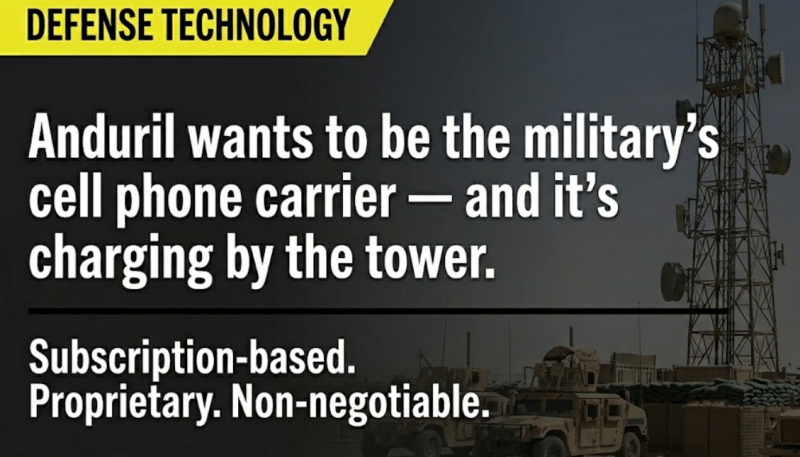
The same company building space weapons and drone defenses now wants control of your battlefield communications infrastructure.
WASHINGTON — Anduril Industries is not satisfied controlling your border surveillance, your drone defenses, or your space-based interceptors. It wants to be your communications provider too.
The company this week unveiled the 5G Comms Sentry Tower, a deployable private cellular network built on its existing Sentry surveillance tower platform and Nokia Federal Solutions hardware. The pitch is simple: existing communications infrastructure fails in remote military environments, and Anduril can fix it. Rapidly. Affordably. On its terms.
Those last two words are doing a lot of work here.
The 5G CST is not sold. It is delivered as a service. That means the military — and by extension the American taxpayer — does not own the infrastructure. It rents it. From Anduril. Indefinitely. The company's own announcement describes a model where users pay for network access rather than data usage, which sounds consumer-friendly until you consider that the customer in this scenario is the United States military and the product being rented is the communications backbone connecting soldiers, sensors, weapons systems, and classified operations in the field.
Anduril built this system on top of its Lattice software platform — the same proprietary command-and-control system it is embedding in Dutch air defenses, pitching for Golden Dome, and marketing to every defense customer it can reach. Every new product Anduril announces runs through Lattice. That is not a coincidence. That is a strategy. The more systems that depend on Lattice, the more indispensable Anduril becomes, and the harder it is for any government customer to walk away from the relationship without dismantling the architecture it has built around Anduril's software.
That is called lock-in. In the commercial technology industry, it is a well-documented business model. In national defense it is something more serious — because the leverage it creates does not stay in a boardroom. It follows soldiers into the field.
The announcement touts the system's ability to deploy in under three hours and operate without any external power or networking infrastructure. Those are genuine capabilities with genuine military value. Nobody disputes that communications in austere environments is a real problem or that existing solutions have real limitations.
What is worth disputing is whether the answer to that problem should be a subscription-based private cellular network owned and operated by a venture-backed Silicon Valley startup whose investors include some of the most politically connected figures in the current administration.
Anduril was founded by Palmer Luckey, who was fired from Facebook and pivoted to defense contracting with the explicit goal of disrupting the traditional defense industrial base. The company has been remarkably successful at that disruption — not by winning wars, but by winning contracts, embedding its software in government infrastructure, and building a product ecosystem so interconnected that replacing any part of it means replacing all of it.
The 5G CST is the latest piece of that ecosystem. Surveillance towers. Drone defense. Space interceptors. Battlefield communications. Each product announced in isolation. Each one feeding the same Lattice backbone. Each one making the next contract easier to justify and harder to refuse.
At 400 towers globally and growing, Anduril is no longer a startup disrupting defense. It is becoming the infrastructure. And unlike the Pentagon's own systems — which are subject to congressional oversight, inspector general reviews, and public accountability — Anduril's infrastructure is proprietary, privately held, and answerable primarily to its shareholders.
The military has a communications problem. Anduril has a business model. Those two things are not the same thing — and the fact that they are increasingly being treated as if they should concern everyone who cares about who ultimately controls the systems that connect American forces in the field.
Anduril calls this closing the communications gap. What it is actually closing is its grip.

Add comment
Comments