

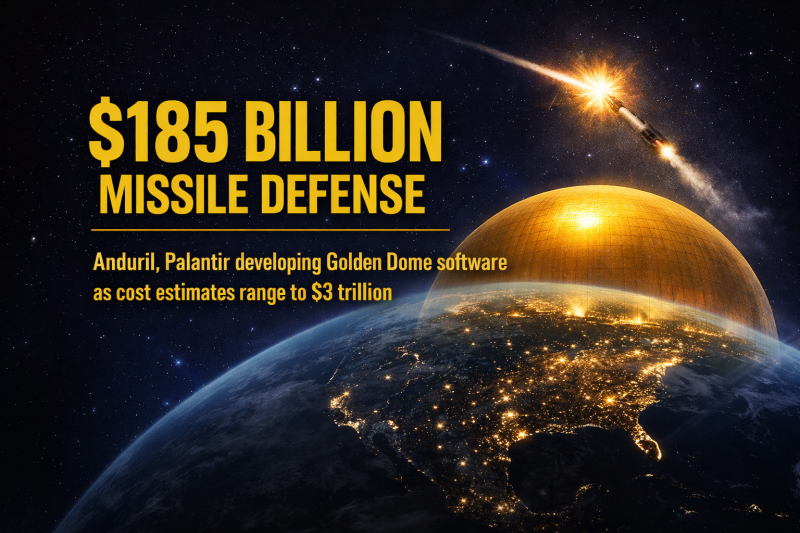
Tech firms developing software for Trump's $185 billion missile defense system amid cost disputes
Trump promised a $175 billion missile shield in 3 years — it's now $185B, won't finish until 2035, and could cost $3 trillion
Two technology companies are developing command-and-control software for President Donald Trump's Golden Dome missile defense initiative, a project whose projected costs have ranged from $175 billion to more than $3 trillion depending on the source, according to industry reports and congressional analyses.
Anduril Industries and Palantir Technologies are working together on software that would link radars, satellites, sensors and interceptors for the space-based shield, according to a source familiar with the matter who spoke to Reuters on March 24. The companies are part of a consortium that also includes Aalyria Technologies, Scale AI and Swoop Technologies, according to the source.
The Golden Dome project aims to build a multilayered defense system capable of intercepting ballistic, cruise and hypersonic missiles, according to Trump's May 20, 2025, announcement. The system would deploy sensors and interceptors across land, sea and space, according to the White House.
Cost Estimates Disputed
The project's price tag has been a point of contention since its inception. Trump initially estimated $175 billion when he announced the initiative in May 2025, according to his Oval Office press conference. Gen. Michael Guetlein, director of the Golden Dome program, said in March 2026 that the cost had risen to $185 billion to fund "additional space capabilities," according to statements at the McAleese Defense Programs Conference.
However, other estimates paint a far more expensive picture. The Congressional Budget Office projected costs between $161 billion and $831 billion over 20 years for space-based interceptors alone, according to a May 2025 letter to lawmakers. Todd Harrison, a senior fellow at the American Enterprise Institute, calculated that a robust defensive architecture could cost as much as $3.6 trillion over 20 years, according to a Bloomberg analysis published in December 2025.
A Bloomberg analysis found the final price tag for comprehensive protection against multiple adversaries could reach $1.1 trillion, more than 500 percent higher than Trump's estimate, according to the December 2025 report.
Timeline Pushback
Trump said in May 2025 that the system would be "fully operational before the end of my term" in 2029, a three-year timeline, according to his announcement. Guetlein said in March 2026 that the system would be complete in 2035, according to his conference remarks.
"The president did ask us to rapidly change the defensive equation of the nation as fast as we possibly can and put a marker on there for the summer of 2028," Guetlein said, according to MeriTalk. He said a 2028 benchmark would demonstrate initial capability with operational systems deployed in the field, according to his remarks.
Defense and budget analysts say the project is likely to take at least a decade to complete, according to a Washington Post analysis published in October 2025.
Company Roles and Backgrounds
Palantir Technologies, known for data-analytics platforms used by the U.S. military and intelligence agencies, is expected to handle artificial-intelligence and integration work, according to the Wall Street Journal. The Pentagon recently designated Palantir's Maven artificial intelligence system as a "program of record" for battlefield command-and-control, according to a March 2026 announcement.
Anduril Industries, founded in 2017 by Palmer Luckey, develops autonomous systems and sensors for military applications, according to company information. Luckey previously founded virtual reality company Oculus, which Facebook acquired for $2 billion in 2014, according to public records. Luckey left Facebook in 2017; he told 60 Minutes in a May 2025 interview that his departure followed a $9,000 donation "to a political group that was for Donald Trump and against Hillary Clinton."
Anduril received multiple small Golden Dome contracts in November 2025 to build competing missile defense prototypes, according to Reuters. The company is currently raising up to $8 billion at a valuation of approximately $60 billion, according to Bloomberg reports.
Rosenblatt analyst John McPeake said Palantir's contribution to phase one of Golden Dome could be worth "many billions of dollars," according to a March 2026 research note. Palantir's total revenue for 2025 was approximately $4.48 billion, according to the company's financial reports.
Other Contractors and SpaceX Involvement
Lockheed Martin, Northrop Grumman and RTX previously joined the program as prime contractors, according to Reuters. The Wall Street Journal reported that SpaceX is "set to receive" a $2 billion contract to build a 600-satellite constellation for missile targeting, according to December 2025 reporting.
Reuters reported in 2025 that Anduril and Palantir were working with Elon Musk's SpaceX on various parts of the project, according to earlier coverage.
In May 2025, 42 members of Congress formally asked the Defense Department Inspector General to review Musk's involvement in Golden Dome, citing concerns over "deviations from standard acquisition processes" and a subscription model that could "give Musk undue influence over national security," according to the congressional letter.
Congressional and Expert Criticism
Sen. Jack Reed, the top Democrat on the Senate Armed Services Committee, said in May 2025 that the White House requested $113 billion in its budget without outlining a clear plan, calling it "essentially a slush fund at this point," according to ABC News.
Sen. Roger Wicker of Mississippi, chairman of the Senate Armed Services Committee, promised to include a $25 billion "down payment" in spending legislation, according to ABC News. Congress approved $25 billion for the project in the One Big Beautiful Bill Act in 2025, with another $13 billion allocated for fiscal year 2026, according to legislative summaries.
"The truth is, we're pretty vulnerable," said Tom Karako, director of the Missile Defense Project at the Center for Strategic and International Studies, according to ABC News. Karako said the current U.S. system is designed mostly to counter intercontinental ballistic missiles from North Korea, not threats from China or Russia, according to his May 2025 remarks.
Todd Harrison of the American Enterprise Institute said Trump's timeline "was unrealistic from the beginning," according to Bloomberg.
International Reactions
China's Foreign Ministry spokesperson Mao Ning criticized the plan on May 21, 2025, claiming it "violates the principle of peaceful use of space in the Outer Space Treaty" and called on the U.S. to abandon the system, according to ministry statements.
Canada's ambassador to the United Nations, Bob Rae, compared Golden Dome to a "protection racket" after Trump said Canada must pay $61 billion to join or agree to annexation. Rae noted that "threats to sovereign integrity are prohibited" under the UN Charter, according to his statements.
Software Testing Planned
The consortium plans initial testing of the command-and-control software this summer, according to sources who spoke to the Wall Street Journal. The software would connect radars and sensors to detect and track airborne threats and allow operators to control weaponry used to intercept those threats, according to reporting.
Space Force Gen. Michael Guetlein, director of the Golden Dome initiative, described the software as a "glue layer" that would enable officers to manage radars, sensors and missile batteries across military services, according to GovConWire.
The Missile Defense Agency said in December 2025 that approximately 1,000 companies were deemed eligible to move forward with proposals that could support Golden Dome. Those companies are eligible for funding from a pool of $151 billion that has not yet been allocated, according to Bloomberg.
Neither Anduril nor Palantir responded to requests for comment on their Golden Dome involvement, according to Reuters.
Add comment
Comments
Paramount informaiton. Jason Salley is on the front lines in delivering this 411. God Bless Jason Salley!