


Billions in global investment, nuclear ambitions, and unanswered questions surround Ohio’s largest proposed development
Feds announce $33 billion gas plant on contaminated Pike County land they still won't compensate
The U.S. Department of Energy and the Department of Commerce announced Friday a public-private partnership with SoftBank and AEP Ohio to build one of the largest energy and artificial intelligence complexes in the country on the grounds of the former Portsmouth Gaseous Diffusion Plant in Pike County — a federal site that has been under environmental cleanup and is still not finished.
The project, officially named the PORTS Technology Campus, would include 9.2 gigawatts of new natural gas generation and a 10-gigawatt data center development on DOE land. SB Energy, a SoftBank subsidiary, is also investing $4.2 billion with AEP Ohio to upgrade and build new transmission lines in the region. The DOE says construction is expected to begin this year.
The announcement confirms what the administration had not previously acknowledged: the $33 billion gas plant is being built to power an AI data center campus. SoftBank Chairman and CEO Masayoshi Son said it plainly in the DOE's own press release: "AI will transform every industry, and the PORTS Technology Campus will help deliver the next-generation infrastructure needed to unlock those breakthroughs."
The gas generation is financed entirely by Japan under a $550 billion U.S.-Japan trade deal. SoftBank holds no equity in the plant and would collect developer fees over 15 to 20 years. The company has already placed a $10 billion order for nearly 170 gas turbines from GE Vernova.
What's Being Proposed for a Single Site
The gas megaplant and data center campus are not arriving in a vacuum. They are being layered onto the same former Portsmouth Gaseous Diffusion Plant property, where at least three other major energy projects have been announced in recent months. Not one of them has broken ground. The site itself has not been fully remediated.
Oklo Inc. and Meta announced a proposed 1.2 GW nuclear power campus. Oklo purchased 206 acres of land at the PORTS reserve for nearly $5.15 million in December 2025. According to the company's own annual report filed with the SEC on March 17, 2026, the land is not currently developed.
But here's what Oklo has never done: built a reactor. Generated a single watt of electricity. Entered into a binding power purchase agreement. The company reported a net loss of $105.7 million in 2025, total operating expenses of $139.3 million with zero revenue, and an accumulated deficit of $240.8 million.
Centrus Energy announced a major expansion of commercial-scale production of High-Assay Low-Enriched Uranium at the Piketon plant. The company says the investment will generate 1,000 construction jobs and 300 new operating jobs. What the company does not advertise is what the DOE's own Inspector General found last July. A four-year audit concluded that the original HALEU demonstration contract was awarded through a process that inappropriately limited competition, bypassed federal contracting rules, and went to a company with significant financial risks and negative equity.
Trillium H2 Power announced plans for a hydrogen power facility. The project's foundation is built on DOE land transfers that the Ohio EPA has publicly challenged. The state agency accused the DOE of providing "false and misleading information" about contamination levels on the parcels being transferred for development.
The Ground Beneath All of It
The Portsmouth Gaseous Diffusion Plant was built in the early 1950s to produce enriched uranium for the nation's nuclear weapons program and later for commercial nuclear reactors. It sits on approximately 3,777 acres in rural Pike County. Gaseous diffusion operations shut down in 2001.
Cleanup started in 1989 under the DOE's Office of Environmental Management, working alongside the U.S. EPA and the Ohio EPA. Thirty-six years later, it is still going.
Decades of operations left behind widespread radioactive and chemical contamination — uranium, technetium-99, PCBs, trichloroethylene, asbestos, and hydrogen fluoride gas — that seeped into the soil, the groundwater, and the air that residents breathed. In 2019, Zahn's Corner Middle School was abruptly closed after neptunium-237, an enriched uranium byproduct, was detected just two miles from the plant. Students had to be relocated.
The Scioto Valley Guardian and community advocates have spent years documenting elevated cancer rates, chronic illness, and death among residents who lived in the shadow of the facility. Families in Pike County have buried their loved ones and watched their neighbors get sick at rates that cannot be explained by coincidence.
Despite that evidence — and despite the federal government's own environmental data confirming the contamination — Pike County has been systematically shut out of the Radiation Exposure Compensation Act. Congress has repeatedly failed to extend RECA coverage to this community.
What the Gas Plant Would Put in the Air
No air quality permits have been filed for the Portsmouth Powered Land Project. But at 9.2 gigawatts, the scale of what is being proposed demands attention.
A natural gas facility of that size would be one of the largest single-source emitters of air pollutants in the country. Natural gas combustion produces nitrogen oxides, carbon monoxide, volatile organic compounds, particulate matter, and carbon dioxide. At full capacity, the annual emissions footprint would dwarf anything currently operating in southern Ohio.
No environmental impact assessment has been made public. No water use or cooling infrastructure plans have been disclosed, despite the facility's proximity to the Ohio River. No public comment period has been announced for any aspect of the project. The DOE press release made no mention of air quality, emissions, or environmental review.
Whether Any of It Can Actually Be Built
The DOE says construction is expected to begin this year. Energy analysts are not as certain.
Gas turbines in the United States are effectively sold out through 2029 or 2030. PJM Interconnection, the largest regional grid operator in the country and the system this plant would need to connect to, said it was not aware of the project before the February announcement. No interconnection application had been filed at the time. The grid operator is currently working through a backlog of applications that have been waiting since 2022.
No siting or construction permits have been filed with Ohio regulators. The plant would need new pipeline infrastructure to deliver natural gas to the facility, which would require additional state and potentially federal approvals.
Dennis Wamsted, an energy analyst with the Institute for Energy Economics and Financial Analysis, said he doubts the project will be built at the scale described. He pointed to supply chain constraints, competition for skilled labor, and the sheer complexity of a project this size.
Then there is the trade deal itself. Three days after the gas plant was announced in February, the U.S. Supreme Court ruled against the broad tariff program the Trump administration used to extract trade concessions from Japan. If the tariff framework collapses, the leverage that produced Japan's $550 billion investment commitment could go with it.
A Concentration of Risk with No Public Security Plan
There is another dimension to what is being proposed in Piketon that no official has publicly addressed: security.
If everything announced for this site were actually built, Pike County would house a 9.2-gigawatt natural gas megaplant, a 10-gigawatt AI data center campus, a hydrogen power facility, two nuclear reactors, a uranium enrichment operation, and the infrastructure connecting all of it to the nation's largest power grid — side by side — in a rural Appalachian community with no military installation, no major law enforcement hub, and limited first-responder capacity.
No publicly disclosed security assessment exists for the cumulative risk of co-locating this many high-value energy and technology assets in a single place.
Pike County has a population of roughly 28,000 people. The county seat of Waverly has fewer than 4,000. Local law enforcement and emergency services are built for a rural community. They are not built for the protection of a multi-billion-dollar energy and AI campus handling nuclear materials and enough natural gas generation capacity to power seven million homes.
Three Cabinet Secretaries and a Golden Shovel
Energy Secretary Chris Wright, Commerce Secretary Howard Lutnick, Interior Secretary Doug Burgum, and SoftBank CEO Masayoshi Son will arrive in Piketon this afternoon for a ceremonial groundbreaking at the DOE Portsmouth site.
What the Community Is Still Owed
Pike County has given more to the federal government's energy ambitions than most communities in the country. Its residents enriched uranium for America's nuclear arsenal. They lived with the contamination that followed. They buried their family members. They compiled the evidence. They made the case. And they were told no.
RECA has never covered Pike County. Not because the contamination didn't happen — the federal government's own records prove it did. Not because people didn't get sick — the cancer clusters and death records speak for themselves. But because Congress chose not to act, and administration after administration chose not to push.
Billions of dollars are about to flow into the same site that poisoned the community around it — to build an AI campus that will power the future of artificial intelligence for Silicon Valley, funded by Japan, operated by a company headquartered in Houston, on land the federal government contaminated and has spent years and billions of taxpayer dollars cleaning up.
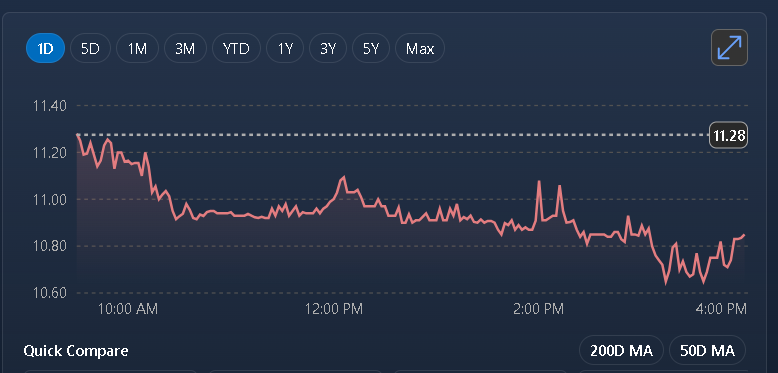
Despite Friday's major announcement, SoftBank stocks ended the trading week in the red.
Add comment
Comments