

The modified permit covers just one of at least 26 emissions units at the 731-acre Ohio River chemical plant — and the full scope of what the facility is authorized to release remains unanswered.
HAVERHILL, Ohio — The Ohio EPA has quietly signed off on a modified air pollution permit for one of the largest chemical plants in the eastern United States — authorizing ALTIVIA Petrochemicals to pump hundreds of tons of volatile organic compounds, ammonia, carbon monoxide and other pollutants into the skies above Scioto County and the Ohio River every single year.
And that's from just one piece of the operation.
The 37-page permit, signed by Ohio EPA Director John Logue and effective March 18, covers a single unit at the 731-acre facility — the phenol wastewater treatment system. ALTIVIA operates at least 25 other permitted emissions units at the same site. Each one carries its own pollution limits.
What they're allowed to put in the air
The numbers in the permit speak for themselves.
From the wastewater treatment equipment alone — not counting the facility's main pollution incinerator or equipment leaks — ALTIVIA is authorized to release up to 34.95 tons per year of volatile organic compounds, 4.33 tons per year of acetone and 33.82 tons per year of ammonia.
The facility's regenerative thermal oxidizer — a high-temperature unit designed to burn off hazardous chemicals before they leave the stack — is permitted to release up to 27.04 tons per year of VOCs including acetone, 33.11 tons per year of carbon monoxide, 7.25 tons per year of nitrogen oxides and three tons per year of particulate matter.
Then there are the leaks. Not accidental spills. Not malfunctions. Permitted, anticipated, authorized leaks from valves, pumps, connectors and seals across the entire plant. The permit caps those "fugitive" emissions at 187 tons per year of volatile organic compounds, 80 tons per year of acetone and 193 tons per year of ammonia.
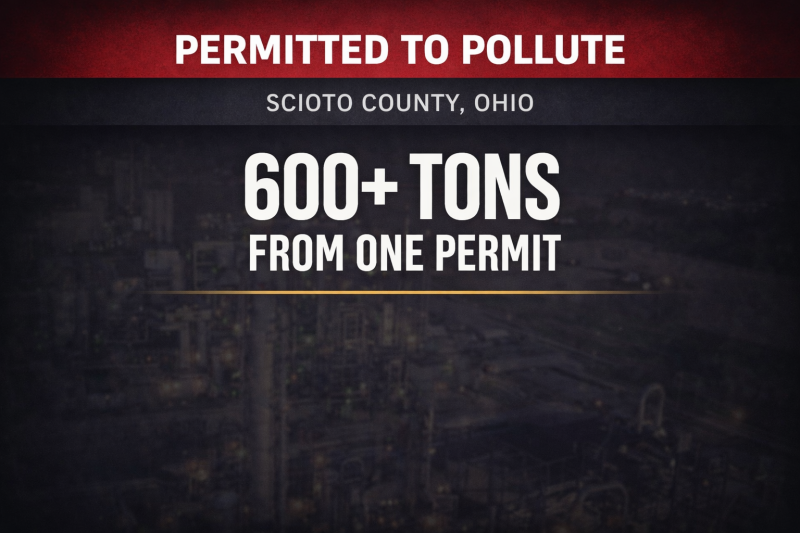
Add it all up and this one permit authorizes more than 600 tons of regulated pollutants per year.
Ammonia pouring off storm water tanks
Buried in the permit's equipment tables is a detail that may surprise residents downstream of the plant.
Four storm water tanks and a diversion sump at the facility are authorized to release volatile organic compounds and large volumes of ammonia — and none of them have pollution control devices.
Storm water tank 2441-F alone is permitted to release up to 96 pounds of ammonia per day. Tank 2440-F is allowed nearly 70 pounds per day. A third tank adds another 18 pounds per day. Combined, the three tanks are authorized to release more than 184 pounds of ammonia per day and roughly 34 tons per year — all uncontrolled.
The question that raises is straightforward: if that much ammonia is venting from the storm water system, what is in the water itself?
The classification that matters
The permit identifies the ALTIVIA plant as a "Synthetic Minor to Avoid Major" source. In plain terms, the company has accepted pollution caps on paper that keep it just below the threshold where the strictest federal air quality rules kick in.
That means no Prevention of Significant Deterioration review. No New Source Review. No continuous emissions monitoring. No major greenhouse gas classification.
For a 731-acre petrochemical complex that is the third-largest producer of merchant phenol and acetone in the Americas, sitting on the banks of the Ohio River, that classification means the surrounding community gets fewer protections than it otherwise would.
A company the feds already caught cheating
This is not a company operating with a clean record.
In September 2022, the U.S. EPA announced a settlement with ALTIVIA for alleged violations of the Clean Air Act at this same facility. The company paid a $1,112,500 civil penalty for failing to monitor and repair leaking equipment, failing to demonstrate compliance and failing to control hazardous air pollutant emissions as required.
The DOJ's seven-count complaint, filed in October 2021, alleged ALTIVIA violated Clean Air Act requirements to monitor and repair leaking equipment and control hazardous air pollutant emissions. Those violations involved the exact same type of fugitive emissions — leaks from valves and connectors — that this permit now authorizes at up to 460 tons per year.
The consent decree required ALTIVIA to implement more frequent monitoring, better repair practices and replacement of old valves with low-emission models. The company was also ordered to install controls on a process tank that had been operating with no pollution controls at all. The projected cost was $730,000 — a fraction of what the company earns as one of the largest phenol producers in the Western Hemisphere.
The plant's history goes back further. Before ALTIVIA bought the facility out of bankruptcy in 2015, the previous operator, Haverhill Chemicals, shut down after an employee was fatally injured at the plant in April 2014. OSHA cited the company for 21 serious violations, many of them process-safety related.
What the modification actually changed
The Ohio EPA initiated this permit modification itself — not at ALTIVIA's request. According to the permit, the agency corrected errors in hazardous air pollutant language from a 2024 permit and updated emission limits on the regenerative thermal oxidizer to match a subsequent permit issued in October 2025.
The modification carried no fee. It required no public comment. It took effect the same day it was signed.
The bigger question no one has answered
This permit covers one emissions unit — P009, the phenol wastewater treatment process. But according to the permit's own facility-wide terms, at least 25 additional emissions units at the Haverhill plant are subject to federal hazardous air pollutant regulations: J004, J006, J008, J011, P001, P006, P007, P008, P012, P013, T023, T024, T025, T026, T033, T029, T030, T034, T039, T045, T046, T059, T063, T064 and T065.
Every one of those units has its own permit. Its own emission caps. Its own authorized pollution.
If a single permit for a single unit at the ALTIVIA plant authorizes more than 600 tons of pollutants per year, the question that demands an answer is simple: what is the total across all 26?
Add comment
Comments
I breathe. What are you putting into my air?
The wind blows toward other Counties. Did they agree to this 'permission' to pollute their air?
The Ohio River flows. I drink water drawn from it. Other Citizens in numerous counties in Ohio, Indiana, Kentucky, Illinois, draw water from the river.
Were they consulted about this 'permission'?