

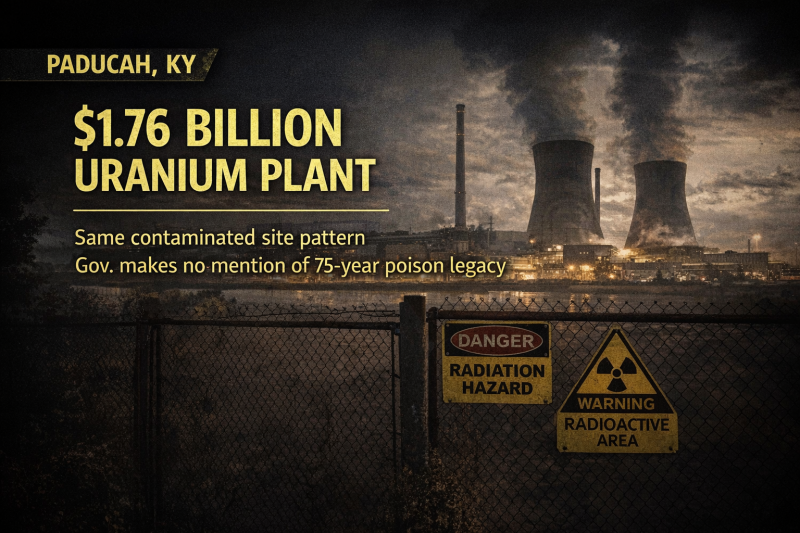
Gov. Andy Beshear touts 240 jobs and economic development while making no mention of decades of radioactive contamination that mirrors Pike County's Atomic Plant
Kentucky announces $1.76 billion uranium enrichment facility at contaminated Paducah site — same pattern as Portsmouth
Kentucky Gov. Andy Beshear announced Wednesday what he called "the single largest capital investment in Western Kentucky history" — a $1.76 billion uranium enrichment facility at the site of the former Paducah Gaseous Diffusion Plant, a federal facility with a contamination history that mirrors the Portsmouth plant in Pike County, Ohio.
Global Laser Enrichment plans to build the Paducah Laser Enrichment Facility on 665 acres adjacent to the U.S. Department of Energy's former gaseous diffusion complex. The project would create 240 jobs with an average wage of $62 per hour, including benefits, according to the governor's announcement.
The pattern is identical to what is happening in Pike County.
The Same Site, The Same Pitch, The Same Omissions
The Paducah GDP and the Portsmouth GDP were twin facilities built in the early 1950s as part of the nation's nuclear weapons program. Both used gaseous diffusion technology to enrich uranium. Both operated for decades. Both were shut down in the early 2000s. Both left behind contamination that has not been fully remediated.
And now both are being pitched as sites for new nuclear and energy infrastructure with promises of jobs and economic development — while the contamination that poisoned workers and surrounding communities goes unacknowledged in official announcements and uncompensated by the federal government.
In Pike County, the DOE announced a $33 billion natural gas megaplant and AI data center campus, two nuclear reactors, expanded uranium enrichment, and a hydrogen facility — all on the contaminated Portsmouth GDP site. Pike County residents, who documented elevated cancer rates and chronic illness linked to the facility, have been systematically excluded from the Radiation Exposure Compensation Act.
In Paducah, Gov. Beshear's announcement makes no mention of contamination, worker illness, or environmental review. Instead, it frames the project as "a game-changing investment" that will "transform our economy" and "create opportunities for Kentucky families for generations."
What the Paducah Site Left Behind
According to the DOE's own records and environmental assessments, operations at the Paducah GDP resulted in contamination of soil, groundwater, and air with uranium, technetium-99, polychlorinated biphenyls (PCBs), trichloroethylene (TCE), and other hazardous materials.
A 2014 report by the Government Accountability Office found that cleanup at the Paducah site was expected to take until at least 2062 and cost an estimated $7.4 billion. As of 2024, cleanup was still ongoing and the timeline had been extended.
Workers at the Paducah plant have reported elevated rates of cancer and other illnesses linked to radiation and chemical exposure. A 2000 investigation by the Department of Labor found that Paducah workers were exposed to plutonium, neptunium, and other radioactive materials without being informed of the risks. Some workers were used in radiation experiments without their knowledge or consent.
And now the state is celebrating a $1.76 billion uranium enrichment facility on the same site.
What Global Laser Enrichment Is Proposing
GLE describes its technology as "the world's most advanced uranium enrichment" method. The company was formed in 2007 and currently operates a pilot plant in Wilmington, North Carolina. The Paducah facility would be its first commercial-scale deployment.
The project is "currently under license application review by the Nuclear Regulatory Commission," according to the governor's announcement. That means it has not been approved. The NRC's review process can take years and require environmental impact assessments, safety evaluations, and public comment periods.
Once licensed — if licensed — the facility would "re-enrich over 200,000 metric tons of high-assay depleted uranium under a 2016 contract with the U.S. Department of Energy," according to the announcement.
The DOE recently awarded GLE up to $28.5 million to support the project. Kentucky is offering $24 million in tax incentives over 15 years under the Kentucky Business Investment program, plus up to $3 million in sales and use tax relief through the Kentucky Enterprise Initiative Act.
GLE has invested more than $550 million in "privately funded engineering, design, manufacturing and licensing" across North Carolina and Kentucky, according to the announcement.
The Pattern
What is happening in Paducah and Pike County is not coincidence. It is a pattern.
The federal government identifies rural communities near former nuclear weapons facilities — sites it contaminated and has not fully remediated — and pitches them new nuclear and energy infrastructure projects with promises of jobs and economic development.
The contamination history is downplayed or omitted entirely. Worker illness and community health impacts are not mentioned. Environmental review is framed as bureaucratic delay rather than necessary due diligence. Opposition is characterized as anti-progress or anti-jobs.
Tax incentives, federal awards, and private investment are announced with fanfare. Elected officials celebrate. Press releases use words like "game-changing" and "transformational" and "leadership."
Pike County has given more to the federal government's nuclear ambitions than most communities in America. Its residents enriched uranium for the nation's nuclear arsenal. They lived with the contamination that followed. They documented the cancer clusters and the deaths. They were excluded from RECA. And now they are being asked to accept a $33 billion gas plant, an AI data center, nuclear reactors, and expanded uranium enrichment on the same contaminated ground.
Paducah's story is the same. Workers enriched uranium for 61 years. Communities lived downwind and downstream. People got sick. Compensation was denied. Cleanup is still ongoing.
And now both communities are being told this is economic development.
The Questions Nobody Will Ask
At what point does the federal government owe these communities something other than another industrial project on contaminated land?
At what point does "economic development" require acknowledging what the first round of development cost?
And at what point do governors and mayors and county officials stop celebrating billion-dollar investments on sites that poisoned the people they were elected to represent — and start demanding that those people be made whole first?
Paducah deserves better than a press release that erases 75 years of contamination to sell uranium enrichment as progress.
Pike County deserves better than being told a gas megaplant is economic opportunity.
And both communities deserve elected officials who will say it out loud.
Global Laser Enrichment did not respond to questions about environmental review, worker safety protocols, or community health assessments.
The U.S. Department of Energy did not respond to questions about the status of cleanup at the Paducah site or whether new uranium enrichment operations would affect the remediation timeline.
Add comment
Comments
Shame on you Governor Beshear. You make an announcement about jobs, but no mention of contamination, worker illness, or environmental review.