

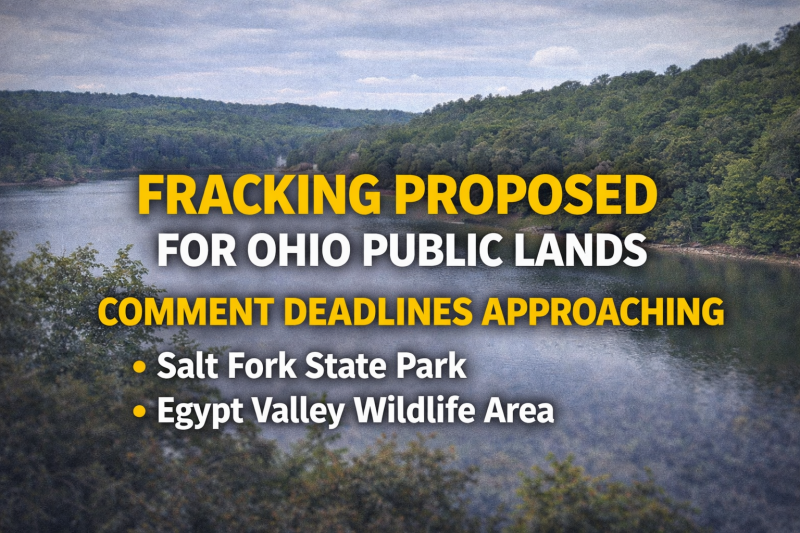
COLUMBUS, Ohio — Nearly 9,000 more acres of Ohio public land could soon be opened to fracking — and a grassroots environmental group says the public has only days to stop it.
Save Ohio Parks is urging Ohioans to submit comments opposing proposed oil and gas development beneath 8,749 acres at Egypt Valley Wildlife Area in Belmont County and Salt Fork State Park in Guernsey County.
The group says 6,639 acres at Egypt Valley face a March 7 public comment deadline under nominations 26-DNR-0001 and 26-DNR-0002. An additional 1,596 acres at Egypt Valley and 513 acres beneath Salt Fork State Park carry a March 15 deadline.
If approved, the nominations would push the total amount of Ohio public land approved for fracking since 2023 to nearly double what has already been authorized.
According to Save Ohio Parks, 11,603 acres of state parks and wildlife areas have already been approved for fracking by the Oil and Gas Land Management Commission since 2023. That includes rights-of-way on Ohio Department of Transportation land and acreage at Noble Correctional Institution.
Egypt Valley Wildlife Area spans roughly 18,000 acres and is popular for hiking, fishing and hunting. The land was heavily strip-mined decades ago but underwent years of reclamation beginning in the 1990s.
Salt Fork State Park, at 20,000 acres, is Ohio’s largest state park and was the first park approved for fracking in 2023 despite large citizen protests at commission meetings.
“Everyone who cares about keeping our pristine natural lands from being industrialized and wants to protect our health, our clean air, water and biodiversity in Ohio has a responsibility to act now and tell the OGLMC to say NO to fracking these beautiful, unspoiled land,” said Rebecca Malik, a board member of Save Ohio Parks.
She added that Ohio’s public lands were set aside “for the pleasure and leisure of the people of Ohio for all time” and are “not owned by one governor or a supermajority political party seeking to monetize and destroy them.”
Opponents point to safety and environmental concerns. Save Ohio Parks says research conducted with Fractracker Alliance documented 1,900 oil and gas “incidents” in Ohio since 2015 — averaging roughly one incident every 1.5 days.
In January 2025, an explosion and fire at the Groh well pad about six miles from Salt Fork forced the overnight evacuation of an entire township. Environmental groups subsequently called on Gov. Mike DeWine to declare a moratorium on fracking beneath state parks and public lands. That request has not been granted.
Critics also argue Ohio’s injection well system — where fracking wastewater is disposed underground — lacks sufficient oversight. Washington County, which already has 17 Class II injection wells, remains a focal point of environmental concern.
Lea Harper, director of Freshwater Accountability Project, warned that fracking permanently removes freshwater from Ohio’s natural cycle.
“That water is destroyed by a single boom-bust industry and forced underground forever, never to sparkle in the sun again,” Harper said.
Save Ohio Parks says fracking approved through January 2026 would use at least 1.9 billion gallons of fresh water drawn from Ohio lakes and streams.
The Oil and Gas Land Management Commission will consider the nominations after the public comment deadlines expire.
Residents can review nomination numbers and file comments through the commission’s public portal.
For now, the clock is ticking.
Add comment
Comments
How about no? Stop ruining the ground water. Not like this will change your decision anyway, money hungry retards.
Please do Not allow fracking in Ohio Parks. That land is supposed to be for all. Not for big business to pollute our air and destroy our beautiful nature.